

News and Events

Upcoming Events

Latest News
Pressure Injury Documentation in Aged Care: Why Three Entries Are Not a Chain
Pressure injury documentation in Australian residential aged care follows a familiar pattern. The skin integrity assessment is completed and entered. The wound management form is initiated. The repositioning schedule is added as a care plan action. All three entries exist. All three are thorough. Under routine clinical governance, that is usually where the conversation stops. It stops in...

Restraint Review Currency in Aged Care: What Your Register Cannot Confirm
Every residential aged care provider with active restraints maintains a restraint register. Most also conduct scheduled reviews and document them in progress notes. What most providers do not have is a record that can confirm, without cross-referencing three separate sources, that the review occurred at the documented time, that the consent in place at that moment...

The Handover Record and the Communication Gap
The shift had been busy. The afternoon Registered Nurse completed the handover at 22:00, briefed the incoming night team verbally, and filled in the handover sheet. One resident had shown increased confusion during the afternoon, which the outgoing nurse communicated during the briefing. The night shift came on. The handover sheet was filed. At 02:30, the resident...

The Medication Record Was Complete. The Incident Still Escalated.
There is a version of this scenario in almost every residential aged care facility. A medication incident occurs. It is documented. The MAR shows the administration. The progress note exists. And when the question arrives, whether it’s from a Commission reviewer, from a SIRS investigation, from a board risk conversation, the record cannot answer it....
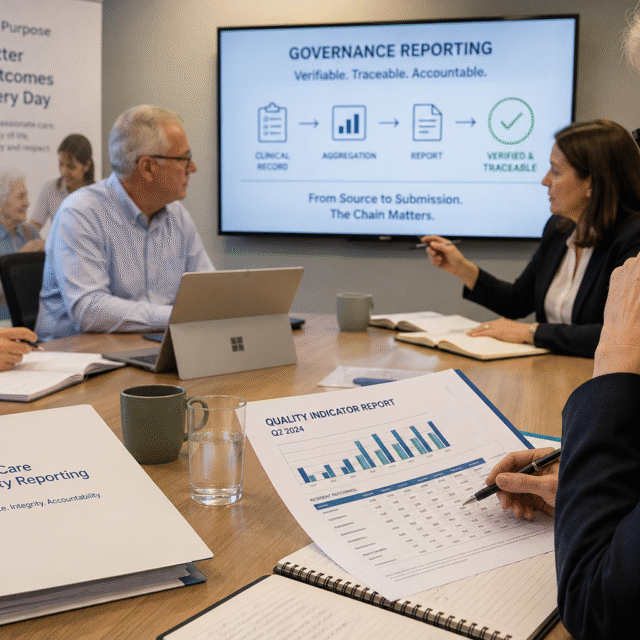
Aged Care Reporting Compliance: When the Submitted Report and the Source Data Are Not the Same Document
A quality report was submitted on time. The figures came from the clinical management system. The board received them, approved them, and they went to government within the statutory timeframe. Fourteen weeks later, an ACQSC surveyor asked one question: where is the source record for this figure? The provider could not answer. Not because the data was wrong....

Signed, but Not Auditable. Care Minutes Attestation and the Contemporaneous Record Gap
You have signed the care minutes attestation. Your registered nurse hours met the benchmark for the reporting period. The reconciliation was completed, reviewed, and filed before submission. Everyone involved in the sign-off was satisfied with the figure. There is no reason to question it now. The ACQSC compliance verification framework does not begin where you...

The Photograph That Could Not Speak for the Wound
The photograph existed. That is the point most facilities do not initially register when they encounter a wound documentation complaint. The images were taken. The assessing nurse photographed the wound at each scheduled assessment. The photographs show what the clinical team observed. The wound management was not the problem. The wound management documentation aged care evidentiary standard, however, is a different and...

When the Record Cannot Answer the Question
The complaint arrived eight months after the incident. A fractured hip following a fall, SIRS-reportable, disclosure conducted the following morning by the clinical manager. By any clinical standard, the conversation had been handled well: thorough, compassionate, appropriate. The progress note confirmed that disclosure had been conducted and that the family had been informed. The complaint alleged the family had been told the fall was unwitnessed....

The Observation Record That Could Not Answer the Question
There is a specific moment in post-fall documentation assembly when a clinical manager encounters a problem the observation log cannot solve. The log is present. The entries are complete. The clinical descriptions are accurate. The care team conducted the rounds. And the timestamps cluster in a way that reveals, to anyone who knows what to look for, that...