
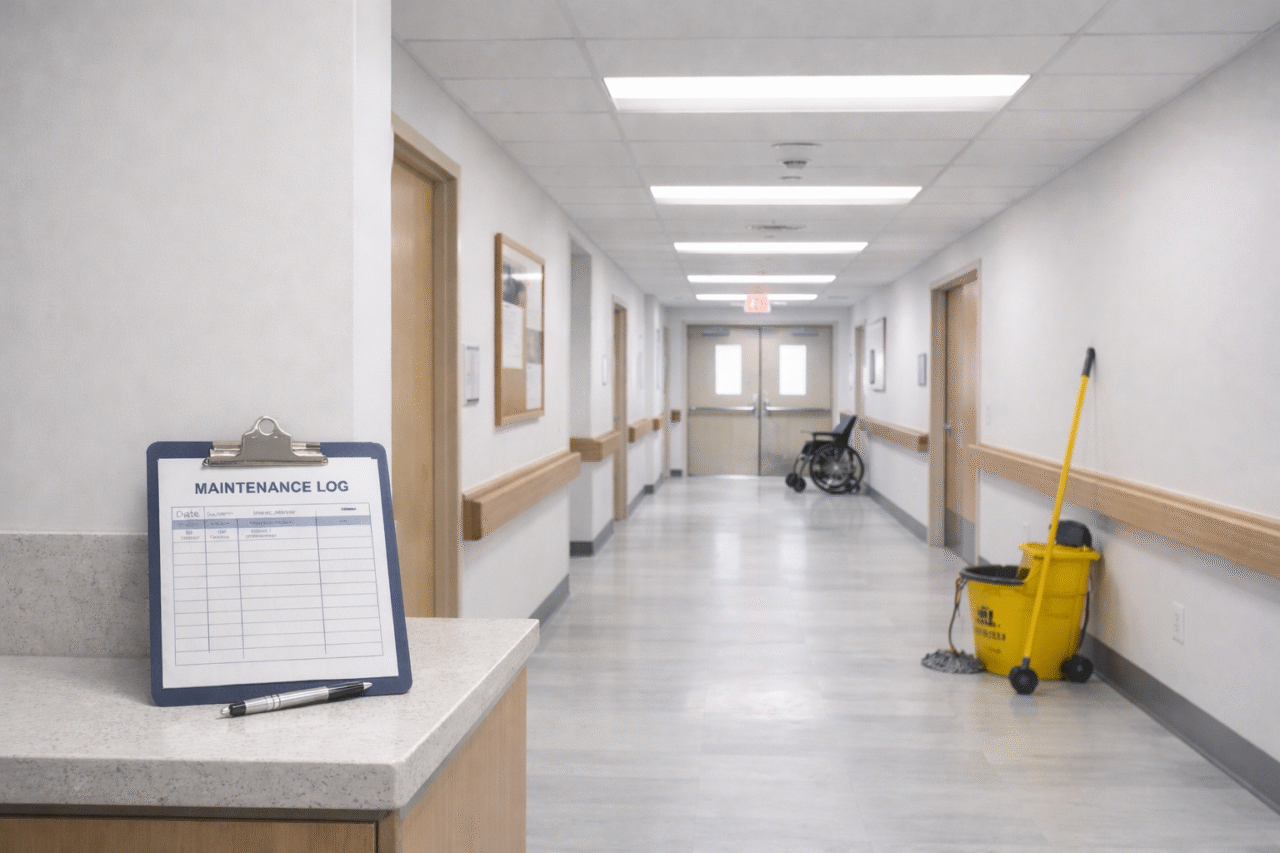
It Was Logged. That Was Not the Problem.
In most aged care homes, environmental faults are not ignored.
- They are documented.
- Work orders are raised.
- Vendors are contacted.
Yet during incident reconstruction, the central question is rarely whether the issue was identified. It is why it remained open.
Logging demonstrates awareness. Resolution demonstrates control. When these two diverge, exposure becomes visible during review.
How Environmental Drift Converts into Clinical Consequence
Maintenance backlog is often treated as an operational inconvenience.
In practice, it sits upstream of clinical risk.
- A lifting shower transition strip becomes a trip hazard.
- A trip hazard becomes a fall.
- A fall becomes a wound.
- A wound becomes an infection risk.
- The originating issue is mechanical.
- The consequence is clinical.
Environmental degradation rarely escalates dramatically. It escalates gradually. Backlog does not need to spike to become dangerous. It only needs to drift.
The Backlog Drift Pattern
In a typical 80-bed facility:
- 18 to 25 maintenance issues logged per week
- 12 to 16 items closed
- Net growth of 4 to 9 items weekly
Over eight weeks, facilities commonly move from fewer than 20 open items to more than 30. Individually, none appear critical. Collectively, environmental risk density increases.
When five or more wet-area issues remain open beyond 14 days in a single facility, exposure is no longer isolated. It is systemic. Drift remains invisible until it correlates with harm.
The Illusion of Control
Most systems are designed to log tasks. Fewer are designed to escalate elapsed time through automatic aging thresholds, role-based accountability, and triggered review points.
Logging architecture records activity. Escalation architecture governs elapsed time. They are not the same.
Common structural weaknesses include:
- “Awaiting quote” functioning as a long-term holding status
- Temporary repairs without expiry thresholds
- Vendor delays without escalation triggers
- No single role accountable for total days open
- Aging reports requiring manual collation
If backlog age distribution cannot be surfaced immediately, resolution remains dependent on individual vigilance. Role-dependent control degrades under volume.
Incident Reconstruction and Discoverability
During internal or external review, maintenance history is reconstructed chronologically.
Visible within minutes:
- Original log date
- Follow-up timestamps
- Duration within specific status categories
- Temporary repair history
- Repeat hazards in the same location
- Vendor delay patterns
The question shifts quickly:
Was it identified?
Yes.
Why was it unresolved?
Elapsed time becomes the central exposure variable. When logging volume increases but resolution speed does not, discoverable risk increases. The organisation appears diligent. Exposure remains active.
Executive Self-Test
Without generating a new report, can leadership state:
- Total open maintenance items per facility
- Percentage older than 14 days
- Percentage older than 30 days
- Number of temporary repairs older than 10 days
- Vendor turnaround variance across sites
If this information cannot be surfaced in under five minutes, elapsed-time governance is not structural.
Frequently Asked Questions
What is deferred maintenance backlog in aged care?
Deferred maintenance backlog refers to logged but unresolved environmental faults within a facility, including flooring defects, lighting failures, handrail instability, wet-area deterioration, and hardware faults.
Backlog becomes a governance risk when elapsed time accumulates without structural escalation.
Why is maintenance backlog a clinical risk issue?
Environmental faults can convert into resident harm through predictable progression. For example:
- Flooring defect → trip → fall → wound → infection risk
- Lighting failure → reduced visibility → medication administration error risk
- Handrail instability → support failure → fracture
- Mechanical degradation becomes clinically significant when resolution is delayed.
How long is too long for a maintenance item to remain open?
Exposure increases when:
- Wet-area hazards remain open beyond 14 days
- Temporary repairs exceed 7 to 10 days without escalation
- Multiple aging items cluster within the same facility
- Elapsed time must be governed through defined structural thresholds, not informal monitoring.
Why is logging not enough to control maintenance risk?
Logging confirms that an issue was identified. It does not confirm that elapsed time is governed.
If aging work orders are not escalated automatically, exposure becomes dependent on individual follow-up. Role-dependent systems degrade as backlog volume increases.
What becomes visible during incident or external review?
During reconstruction, reviewers can quickly identify:
- Original reporting dates
- Duration in open status
- Repeated vendor follow-ups
- Temporary repair persistence
- Aging clusters within specific environments
Chronological delay patterns become visible. That is when exposure shifts from operational to governance-level concern.
What structural mechanisms reduce maintenance-related exposure?
Exposure is reduced when elapsed time is governed through:
- Automatic aging thresholds
- Escalation triggers tied to days open
- Clear accountability for total backlog age
- Vendor turnaround monitoring
- Immediate visibility of aging distribution
Governed elapsed time is more reliable than effort-based follow-up.